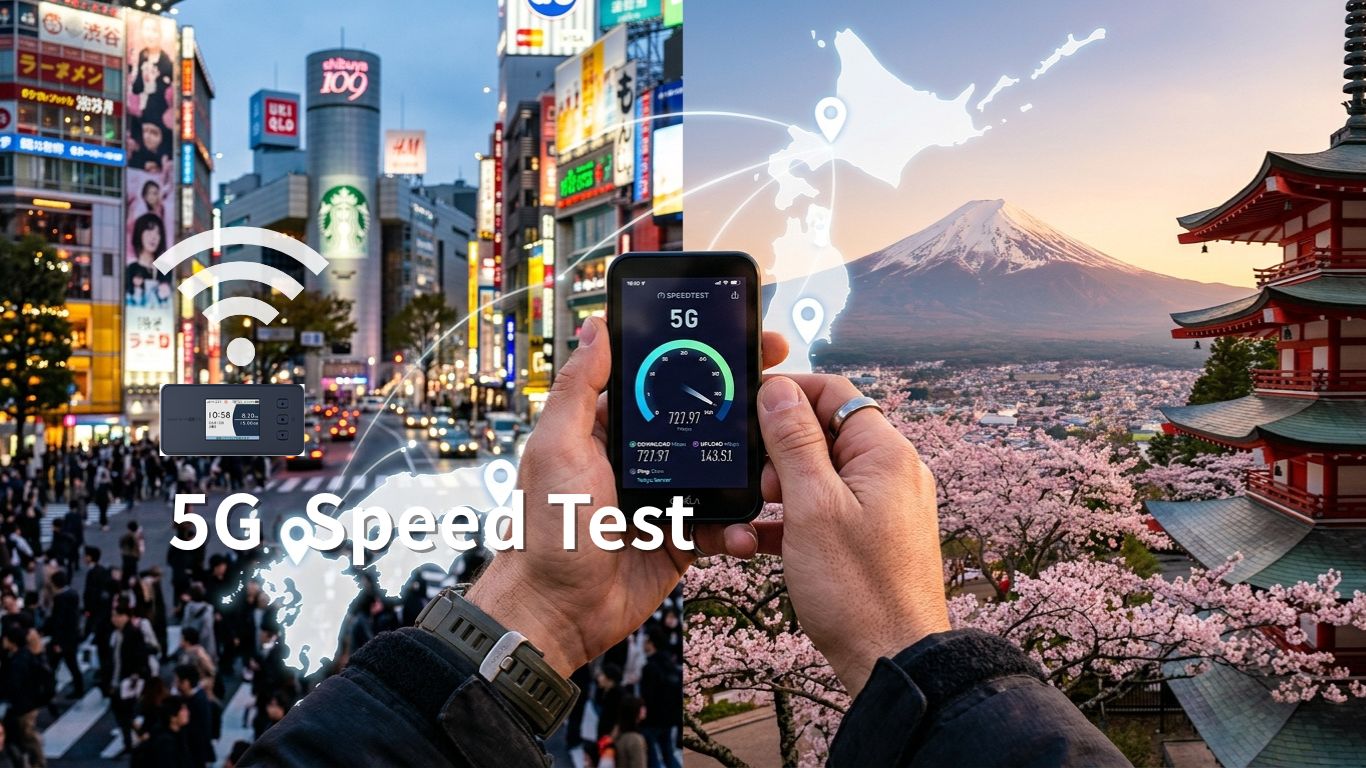
WiMAX+5G Pocket WiFi Speed Test in Japan: Real Results from 8 Locations, Including 5G (2026)
When traveling or staying in Japan, having a reliable and fast internet connection is essential. While eSIMs have surged in popularity recently, many international eSIM services rely on roaming connections that route data through servers abroad. This can lead to noticeable lag—making them less ideal for remote work, streaming high-definition video, or connecting multiple devices simultaneously. In contrast, Pocket WiFi connects directly to local Japanese carrier networks, offering a far more stable and seamless online experience.
Still, the biggest question on every traveler's mind is: "How fast is Pocket WiFi in Japan in reality?" Advertised "maximum speeds" are theoretical numbers created under ideal lab conditions, which rarely reflect real-world daily use.
To give you an honest look, we tested CDJapan Rental’s WiMAX+5G Pocket WiFi across 8 distinct locations in Japan, ranging from downtown Tokyo to rural countryside towns. In this review, we share our unedited speed test results—covering download speeds, upload speeds, latency (ping), and jitter for both 4G/LTE and 5G connections. We reveal everything, including top-tier speeds and location-based speed drops.
If you're still debating between a Pocket WiFi and an eSIM for your trip, check out our in-depth comparison guide: Pocket WiFi vs eSIM in Japan: Which Is Best for Your Trip?
Testing Methodology & Key Metrics
This speed test was conducted by CDJapan Rental team members traveling across Japan between August 7 and August 17, 2026. We used a standard CDJapan Rental WiMAX+5G router and tested performance across a variety of devices, operating systems, and web browsers.
Using industry-standard online speed testing tools (such as Speedtest by Ookla), we measured four vital performance metrics:
- Download Speed: The rate at which data is received. Crucial for web browsing, streaming video, and downloading files.
- Upload Speed: The rate at which data is sent. Important for posting photos/videos, cloud backups, and video conferencing.
- Ping (Latency): Response time in milliseconds (ms). Lower numbers mean quicker response times when clicking links or loading app elements.
- Jitter: The variance in ping over time. Lower values indicate a more stable and consistent connection.
The WiMAX+5G router automatically connects to ultra-fast 5G networks where available and seamlessly switches to 4G/LTE coverage in non-5G areas. Below, we break down our real-world findings for both 4G/LTE and 5G connections.
Real-World 4G / LTE Speed Test Results
The following real-world data includes measurements taken during peak network traffic hours—such as 8:20 PM in Uozu City, Toyama—giving you a realistic representation of real travel and daily usage conditions.
| Date & Time | Location | Device | OS / Browser | Download | Upload | Ping | Jitter |
|---|---|---|---|---|---|---|---|
| Aug 17, 14:49 | Minato-ku, Tokyo | Smartphone | Android / Chrome | 172.6 Mbps | 35.52 Mbps | 30.5 ms | 46.29 ms |
| Aug 17, 10:28 | Iwakuni City, Yamaguchi | PC | macOS / Safari | 19.31 Mbps | 35.24 Mbps | 55.0 ms | 145.31 ms |
| Aug 16, 20:20 | Uozu City, Toyama | PC | macOS / Chrome | 306.97 Mbps | 16.36 Mbps | 43.1 ms | 216.49 ms |
| Aug 16, 11:47 | Toei-cho, Aichi | PC | Windows / Chrome | 79.96 Mbps | 15.56 Mbps | 33.9 ms | 3.8 ms |
| Aug 15, 16:42 | Wakayama City, Wakayama | Smartphone | iOS / Safari | 171.08 Mbps | 40.06 Mbps | 32.0 ms | 1.12 ms |
| Aug 12, 08:22 | Minoh City, Osaka | PC | Windows / Chrome | 163.75 Mbps | 12.91 Mbps | 52.5 ms | 14.1 ms |
| Aug 7, 19:12 | Naniwa-ku, Osaka City, Osaka | Smartphone | iOS / WebKit | 109.89 Mbps | 14.47 Mbps | 36.0 ms | 15.34 ms |
7-Location Averages (4G/LTE Connection):
- Average Download Speed: 146.2 Mbps (Range: 19.31 Mbps – 306.97 Mbps)
- Average Upload Speed: 24.3 Mbps (Range: 12.91 Mbps – 40.06 Mbps)
- Average Ping: 40.4 ms
Real-World 5G Speed Test Results
In designated 5G coverage zones, the WiMAX+5G router automatically locks onto high-frequency 5G signals. Here is the actual measurement recorded during a 5G connection:
| Date & Time | Location | Device | OS / Browser | Download | Upload | Ping | Jitter |
|---|---|---|---|---|---|---|---|
| Aug 11, 08:23 | Muko City, Kyoto | Smartphone | Android / Chrome | 727.97 Mbps | 30.28 Mbps | 36.2 ms | 141.47 ms |
The 5G Speed Advantage Is Real
The download speed on 5G reached a blistering 727.97 Mbps—roughly 5 times faster than our 4G/LTE 7-location average (146.2 Mbps) and more than double our highest recorded 4G/LTE speed (306.97 Mbps in Uozu City, Toyama). If your work or travel demands rapid file transfers or downloading massive 4K video files, connecting via 5G delivers an undeniable performance boost.
To be completely transparent, jitter was somewhat elevated at 141.47 ms in this location. While raw download throughput was exceptionally high, network variability remained on par with a few of our 4G test spots.
Please note that 5G connectivity depends on localized coverage. Even within 5G service zones, physical obstructions (like thick concrete walls) or distance from cell towers may prompt the router to automatically revert to 4G/LTE to maintain connection stability. When traveling outside major metropolitan centers, you will comfortably rely on fast, robust 4G/LTE networks.
Key Takeaways from Our Speed Test Data
1. Blazing-Fast Connectivity in Both Major Cities and Rural Areas
High performance wasn't limited to metropolitan hubs like Minato-ku, Tokyo (172.6 Mbps). Regional areas such as Uozu City, Toyama (306.97 Mbps) and Wakayama City, Wakayama (171.08 Mbps) delivered outstanding speeds. These bandwidth levels effortlessly support 4K video streaming, HD video calls, and multi-device sharing without buffering.
2. Full Transparency: Speed Variances Across Locations
Our test in Iwakuni City, Yamaguchi, recorded a lower download speed of 19.31 Mbps and a higher jitter of 145.31 ms. Local topography, building density, and network load naturally affect signal propagation. Rather than falsely promising uniform maximum speeds everywhere, we share these real-world variations openly. Even at 19.31 Mbps, essential tasks like checking emails, navigating Google Maps, and using messaging apps ran smoothly without interruption.
3. Flawless Compatibility Across Devices and Operating Systems
Whether tested on Android, iOS, macOS, or Windows, the WiMAX+5G Pocket WiFi delivered consistently strong results across every operating system and hardware platform, confirming its universal plug-and-play ease of use.
4. WiMAX+5G vs. Other Japanese Pocket WiFi Providers
In January 2025, Japan travel platform MATCHA published real-world speed test results conducted from their Tokyo office. Their tests showed NINJA WiFi (SoftBank Unlimited plan) averaging 12.88 Mbps download and Sakura Mobile (Unlimited plan) averaging 4.93 Mbps download (Source: MATCHA). Peak urban network congestion in central Tokyo likely influenced those lower figures.
By contrast, CDJapan Rental's WiMAX+5G plan averaged 146.2 Mbps across 7 nationwide locations. While testing conditions (time, weather, exact location) vary, the side-by-side comparison below provides helpful context:
| Provider / Service | Avg Download Speed | Test Location & Conditions | Testing Period |
|---|---|---|---|
| CDJapan Rental (WiMAX+5G) | 146.2 Mbps Avg (19.31 – 306.97 Mbps) | 8 Nationwide Locations (Urban & Rural) | August 2026 |
| NINJA WiFi (SoftBank Line) | 12.88 Mbps Avg | 1 Location (Tokyo Office, 1-hour test) | January 2025 |
| Sakura Mobile | 4.93 Mbps Avg | 1 Location (Tokyo Office, 1-hour test) | January 2025 |
*CDJapan Rental figures reflect an average of 7 nationwide test locations. NINJA WiFi and Sakura Mobile figures are single-location test results published by MATCHA. Provided for general reference only.*
Why Pocket WiFi Offers Better Stability Than International eSIMs
Beyond raw speed, the underlying connection architecture plays a crucial role in overall stability. Many popular overseas eSIM brands (such as Airalo) do not hold direct infrastructure agreements with Japanese mobile operators; instead, they route connection traffic through global data roaming gateways.
According to a technical analysis by Sakura Mobile, this roaming mechanism routes data back and forth to overseas servers, introducing an extra 50 to 150 milliseconds of latency. This latency manifests as noticeable delays when opening webpages or syncing video calls. Furthermore, roaming connections assign international IP addresses, which can trigger security flags or block access to certain local Japanese websites and mobile apps (Source: Sakura Mobile).
Real travelers frequently report these issues. For example, a traveler review noted that after streaming video on an international eSIM, their connection throttled significantly, rendering mobile payment apps unusable (Source: Trip.com). Furthermore, overseas eSIMs depend heavily on whether your foreign phone supports Japan's local cellular frequency bands.
In contrast, CDJapan Rental's Pocket WiFi devices (both WiMAX and SoftBank options) use direct local carrier connections. Because data does not route through international gateways, you avoid severe latency spikes, IP restriction issues, and frequency compatibility glitches regardless of your smartphone model or origin country.
Note: CDJapan Rental also offers direct local carrier eSIMs. Unlike overseas roaming eSIMs, CDJapan's eSIM connects directly to local Japanese networks. However, because eSIMs typically come with capped data allowances, a Pocket WiFi remains the ideal choice for heavy data users, remote workers, or families sharing a connection. Learn more about CDJapan eSIM for Japan.
Who Should Choose the WiMAX+5G Pocket WiFi?
- Travelers who need fast internet for HD video streaming, online gaming, or video calls.
- Visitors planning trips beyond major cities into regional or rural areas.
- Remote workers and business travelers who require high-bandwidth reliability.
- Anyone who prefers reviewing real, transparent speed test data before booking.
Frequently Asked Questions (FAQ)
Will I get the exact same speeds everywhere I go?
Cellular speeds naturally fluctuate based on network traffic, time of day, weather, indoor vs. outdoor surroundings, and distance from cell towers. Our test results represent verified real-world measurements taken at specific times and places, but exact speeds cannot be guaranteed at all times.
What speed test tool was used for this review?
We used industry-standard online testing utilities, including Speedtest by Ookla, to accurately measure download, upload, ping, and jitter metrics.
How does WiMAX+5G compare to SoftBank UNLIMITED plans?
The WiMAX+5G plan excels in delivering ultra-fast 5G speeds in covered areas, making it ideal for maximum bandwidth. The SoftBank UNLIMITED plan operates on 4G/LTE with broader overall coverage across tricky indoor or remote locations. Choose WiMAX+5G if top speed is your primary goal, or SoftBank if maximum coverage area is your main priority.
Verified High-Speed Connectivity: CDJapan Rental WiMAX+5G Plan
- Verified Nationwide Speed: Tested across 8 locations with a 146.2 Mbps 4G average and up to 727.97 Mbps on 5G.
- Genuine Local 5G Connection: Uses direct WiMAX 5G carrier lines—never Cloud SIM routing.
- Satisfaction Money-Back Guarantee: Receive a partial refund if connection quality is unsatisfactory within the first 2 days.
- Flexible Pickup Locations: Pick up at Narita, Haneda, Kansai Airport, or directly at your hotel.
- Hassle-Free Postbox Return: Return from anywhere in Japan using the pre-addressed prepaid envelope.
View WiMAX+5G Plan Details & Rates →
*Planning a long-term stay (3 months or longer)? Check out our WiMAX+5G Long-Term Plans →